Our Expert’s Guide to Treehouses Structure and Safety
Whether we fix a treehouse to the tree or build it alongside on its own supports depends mainly on the size and age of the tree. There is a simple rule of thumb we have arrived at over the years.
The 60cm rule
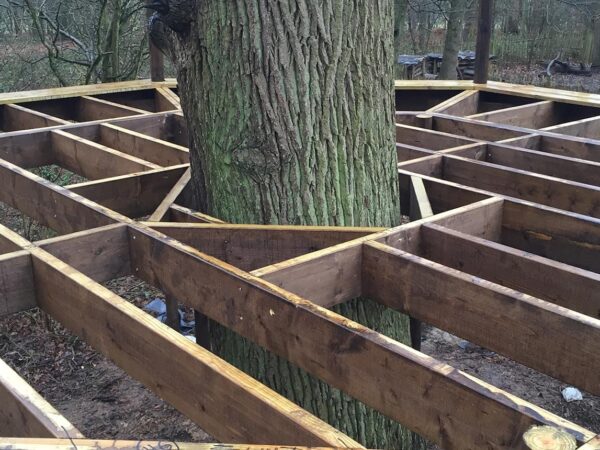
In our experience, if a treehouse is going to be supported by braces fixed directly to the tree, the trunk should be at least around 60cm in diameter. If the tree is smaller than that, we recommend stilts or independent supports instead, rather than fixing the structure to the tree.
That figure holds whatever the species. What matters just as much is the condition of the tree, which must show no sign of disease or rot.
As a tree matures and reaches a good size, its rate of growth generally slows. That makes building into the tree more practical, and reduces the risk of ongoing movement and adjustment later.
Building around the tree rather than into it
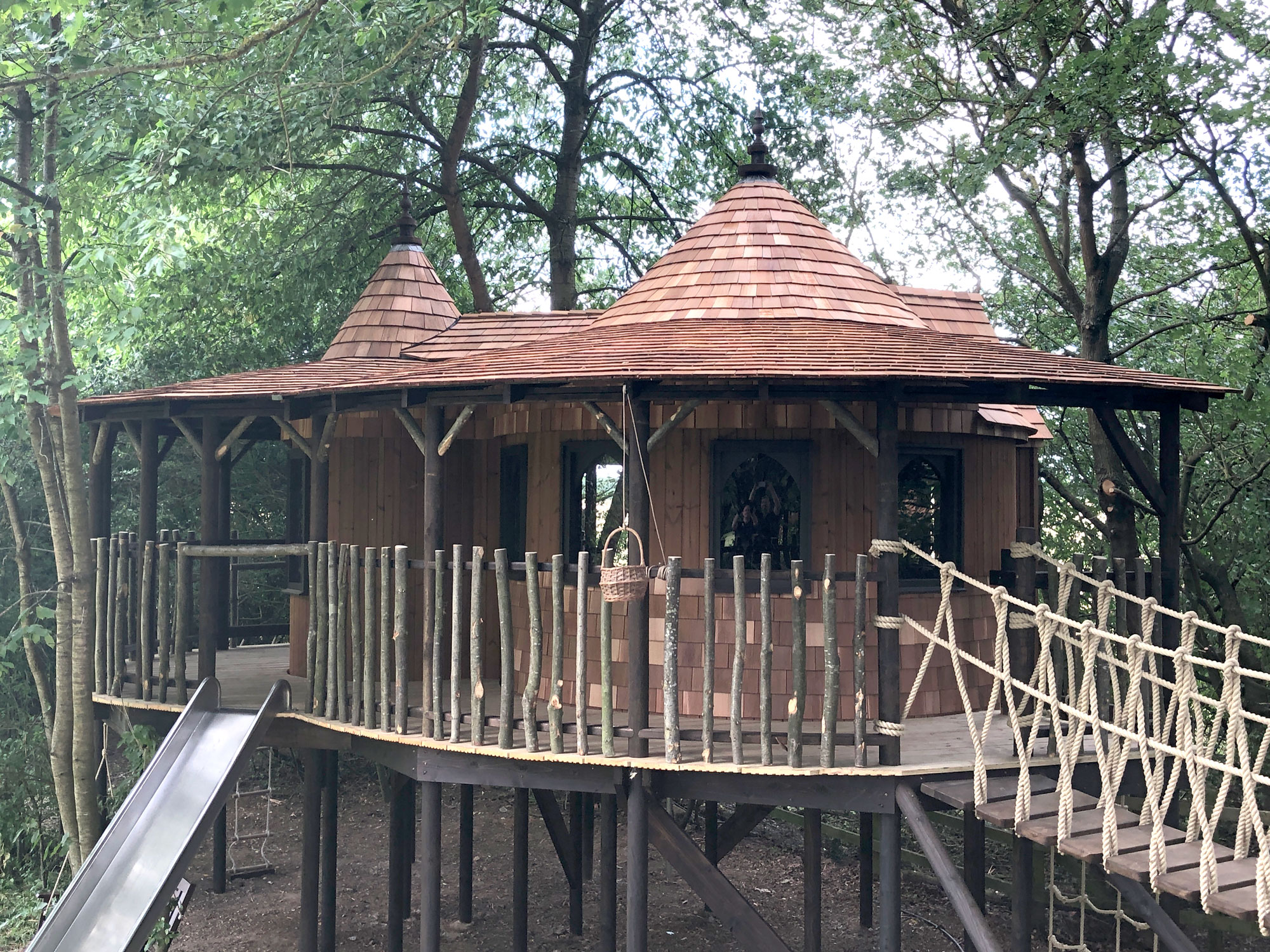
For clients with smaller or younger trees, we often recommend positioning the treehouse next to the tree and supporting it entirely on stilts. The tree’s branches then grow out and over the structure, so you still get the feeling of being up in the trees and connected with nature, with no unnecessary impact on the tree itself.
We recommend the same approach where a tree is covered by a Tree Preservation Order. Keeping the treehouse structurally independent of the host tree is a sensible solution not only for younger trees but also where the tree has extra protection.
The ways a treehouse can be supported
- A single substantial mature tree
- Several trees sharing the load
- A combination of tree supports and ground supported posts
- Specialised treehouse attachment systems
- Structural beams and brackets
The right solution depends entirely on the project. Whatever we use has to give the structure stability while allowing the tree to keep growing and moving naturally. This is where experience, careful engineering and an understanding of how trees behave all come together.