Our Expert’s Guide to Treehouses Trees
The tree should never be the only thing keeping a treehouse standing if there is any question about its long term health. Where we have doubts about a tree, we build on stilts, so the treehouse stays up whatever happens to the tree.
Designing for the future
A treehouse might last for decades, so we have to think about more than how the tree looks today. We ask what condition it is likely to be in 10, 20 or even 50 years from now.
If we have concerns about the condition, species or future stability of a tree, we build the treehouse on stilts and do not rely on the tree for support. If the tree later becomes diseased, has to be removed, or simply reaches the end of its natural life, the treehouse stands on its own.
Ash trees
Ash is a good example. With the ongoing risk of ash dieback, we would be very reluctant to design a treehouse that relies on an ash tree for its structural support. Even if the tree looks healthy on the day we build, we have to think about where it will be many years down the line. There is more on species in which trees are best for a treehouse?
The treehouse we built around a dead oak
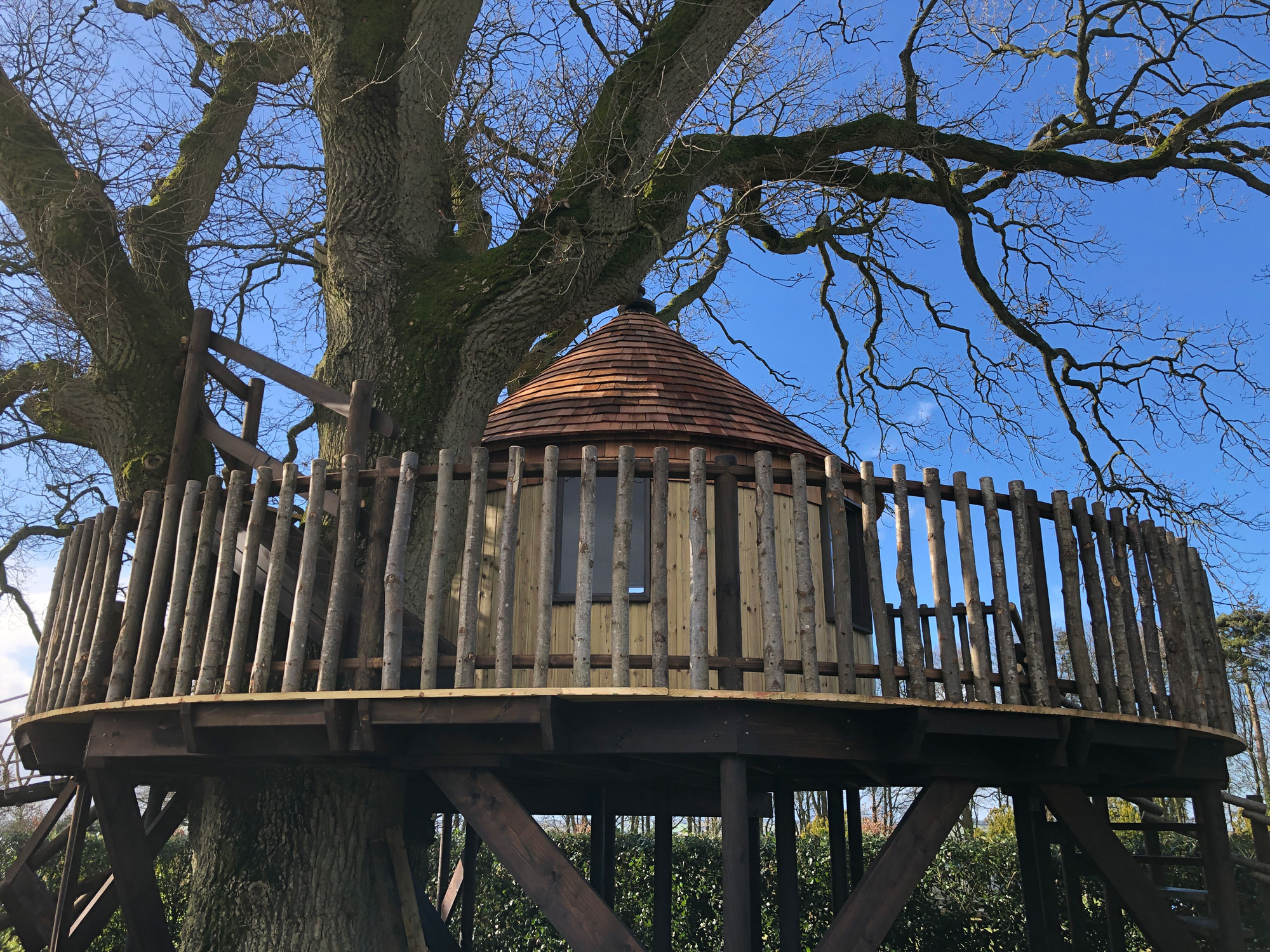
We were commissioned by the Gardens of Easton Lodge in Essex to build a treehouse around an oak that was already completely dead. It replaced a treehouse that stood on the same spot around a hundred years ago, designed by Harold Peto for the Countess of Warwick as a place to entertain up in the tree tops.
We did not treat the dead tree as a problem. We designed the new treehouse around it. The treehouse stands on its own stilts, so the oak carries none of the load. It is there as part of the setting, and it keeps the link with the original.
You can read about the gardens and the treehouse on the Gardens of Easton Lodge website.
A dead tree does not always have to go
A tree that is no longer alive can still have enormous visual and ecological value. It can stay, provided it has been assessed as safe and the treehouse is designed around it and not hung from it.